Tag: HR leadership

The Dallas Health Plan, Part 3: Take Back Control of the Money | Mark Cuban, Chris Deacon, Marilyn Bartlett (Ep. 57 – Part 3 of 3)

The Dallas Health Plan, Part 3: Take Back Control of the Money | Mark Cuban, Chris Deacon, Marilyn Bartlett (Ep. 57 – Part 3 of 3)

Subscribe to my YouTube channel for a lot more: https://www.youtube.com/@BenefitWhisperer

After examining claims visibility and the contract itself, Part 3 asks the most important question: Who should actually be responsible for managing the money?

In the final installment of our three-part series on the City of Dallas health plan, Ralph Weber is joined by Mark Cuban, Chris Deacon, and Marilyn Bartlett to move from diagnosis to possible solutions.

The discussion focuses on what active health-plan management could look like for Dallas and for other employers and public entities funding their own healthcare plans.

Mark Cuban argues that organizations need dedicated expertise capable of reviewing healthcare spending as it happens – rather than relying primarily on audits after the fact. Chris Deacon raises a broader question about how much administration and control public plans should outsource. Marilyn Bartlett brings the conversation back to a fundamental accounting principle: if an employer funds a claim, it should be able to reconcile that funding to what was actually paid.

In this episode:

  • Why healthcare spending should be treated as a major financial responsibility, not simply an HR function
  • Why Mark believes employers need dedicated health-plan expertise
  • Why managing large claims in real time may be more valuable than discovering problems later through an audit
  • The importance of preserving data, RFP, and contractual rights before claims are paid
  • Whether public employers should consider retaining more administrative capability and control
  • How AI and better technology may help – and why expertise still matters
  • Why “disruption” should not automatically be treated as a negative in healthcare
  • The basic accounting question every self-funded employer should be able to answer: Can you reconcile what you funded to what was actually paid?
  • Why long-term healthcare contracts need to account for changing requirements
  • What Mark says employers can gain by taking a more active role in managing healthcare

This is Part 3 of 3 in The Dallas Health Plan: Who’s Watching the Money?

Part 1 – Visibility: What can Dallas actually see?

Part 2 – Contracts & Incentives: What does the fine print actually permit?

Part 3 – Control: What should Dallas and other employers do about it?

Guests:

Mark Cuban – Entrepreneur and Co-Founder of Mark Cuban Cost Plus Drug Company

Chris Deacon – Healthcare attorney and former Director of the New Jersey Division of Pensions & Benefits

Marilyn Bartlett, CPA – Nationally recognized healthcare cost-containment leader and former administrator of the Montana Employee Health Plan

Host:

Ralph Weber | The Benefit Whisperer | Route Three


If this series has changed the way you think about healthcare purchasing, share it with a CEO, CFO, HR leader, benefits professional, public official, or anyone responsible for managing a self-funded health plan. Subscribe to my YouTube Channel as we address more in the healthcare world! https://www.youtube.com/@BenefitWhisperer/

Subscribe to my Substack: https://substack.com/@thebenefitwhisperer

Follow my LinkedIn:  https://www.linkedin.com/in/ralphweber/

Music licensed through Soundstripe.

Code: YTA6TLJZGWC58KTH
The Dallas Health Plan, Part 1: 99% Accurate – – But 99% of What? | Mark Cuban, Chris Deacon, Marilyn Bartlett (Ep. 57 – Part 1 of 3)

The Dallas Health Plan, Part 1: 99% Accurate – – But 99% of What? | Mark Cuban, Chris Deacon, Marilyn Bartlett (Ep. 57 – Part 1 of 3)


Subscribe to my YouTube Channel for a lot more: http://www.youtube.com/@BenefitWhisperer
The City of Dallas is facing rising healthcare costs and the possibility of higher costs or reduced benefits for employees. 
But before making those decisions, there’s a more fundamental question: 

Can the people paying the bills actually see and verify what they’re paying for? 

In Part 1 of this special three-part series of The Benefit Whisperer, Ralph Weber is joined by Mark Cuban, Chris Deacon, and Marilyn Bartlett 
to examine the City of Dallas health plan through the lens of claims visibility, audit rights, contract accountability, and active health-plan management. 

The conversation explores: 

• What does a “99% claims accuracy rate” actually measure? 
• Why claim-count accuracy and claim-dollar accuracy are very different 
• What Mark Cuban found after obtaining and reviewing the Dallas health-plan contract 
• Whether limiting an audit to a small number of claims gives a plan meaningful oversight 
• Why employers need access to their underlying claims data 
• How Marilyn Bartlett approached claims, banking, and large-case management in Montana 
• Why Chris Deacon believes employers must look beyond headline administrative fees and examine the actual contract terms 
• Why Mark argues healthcare needs to be managed like any other major business expense 

One of the central questions in this episode is simple: 

Before asking employees to pay more, shouldn’t the organization funding the health plan know exactly where the money is going? 

This is Part 1 of 3. 
Part 1: What Dallas Can’t See - and Why That Matters 
Part 2: What’s Buried in the Contract and Incentives 
Part 3: How Dallas - and Other Employers - Take Back Control 

Subscribe for Parts 2 and 3: Subscribe to my YouTube Channel and watch the video podcast!

Guests: 
Mark Cuban - Entrepreneur and Co-Founder of Mark Cuban Cost Plus Drug Company 
Chris Deacon - Healthcare attorney and former Director of the New Jersey Division of Pensions & Benefits 
Marilyn Bartlett, CPA - Nationally recognized healthcare cost-containment leader and former administrator of the Montana Employee Health Plan 

Host: 
Ralph Weber | The Benefit Whisperer | Route Three
The Business Model Behind America’s Healthcare Crisis | Elisabeth Rosenthal (Ep. 56)

The Business Model Behind America’s Healthcare Crisis | Elisabeth Rosenthal (Ep. 56)

What happens when healthcare stops behaving like a public good and starts behaving like a financial business?

In this episode of The Benefit Whisperer, Ralph Weber sits down with Elisabeth Rosenthal to examine the business model behind America’s healthcare crisis – and why employers, patients, and families continue to absorb the consequences.

Elisabeth argues that healthcare has increasingly become a financial instrument, shaped by opacity, administrative friction, consolidation, and incentives that often have little to do with delivering better care. The result is a system where patients can become secondary to the transaction, while employers continue funding rising costs without fully exercising their power as purchasers.

Ralph and Elisabeth discuss:

- Why so much money is made from complexity and friction
- How insurers, hospitals, and intermediaries benefit from the current structure
- Why high deductibles and coinsurance can create devastating medical debt
- The growing impact of consolidation and vertical integration
- Whether direct contracting can actually reduce cost and complexity
- Why employers have historically been “asleep at the wheel”
- What self-funded employers should understand about their leverage
- Why transparency matters, but is not enough by itself
- What it will take to create a healthcare market that works better for patients and purchasers
- AND MUCH MORE!

About Elisabeth Rosenthal

Elisabeth Rosenthal is a senior contributing editor for health news analysis at KFF Health News. She joined the organization in 2016 as editor-in-chief after spending 22 years as a correspondent with The New York Times, where she covered healthcare, the environment, and international issues from Beijing.

A graduate of Stanford University and Harvard Medical School, Rosenthal briefly practiced emergency medicine before moving into journalism. Her acclaimed reporting series, Paying Till It Hurts, explored the rising cost of American healthcare, and her book, An American Sickness: How Healthcare Became Big Business and How You Can Take It Back, became a New York Times bestseller.

For CEOs, CFOs, HR leaders, benefits professionals, brokers, TPAs, and anyone responsible for employer-sponsored healthcare, this episode raises a fundamental question: If employers are paying the bill, why aren’t they exerting more control over how healthcare is purchased?

Subscribe and follow for practical conversations about healthcare economics, employer-sponsored benefits, transparency, direct contracting, and strategies for taking greater control of healthcare spending.

Subscribe to my YouTube Channel

Subscribe to my Substack Page

Follow my LinkedIn

Healthcare’s Black Box and a Look Inside It (Ep. 53)

Healthcare’s Black Box and a Look Inside It (Ep. 53)

Employers are funding more of healthcare every year, but many still have limited visibility into what is actually happening inside their health plan.

In this episode of The Benefit Whisperer, Ralph Weber speaks with Dr. Hemant Gupta, a physician executive with experience in hospital medicine, physician advisory work, utilization review, informatics, and medical management.

The conversation focuses on what employers should understand about medical management, prior authorization, denials, appeals, clinical alignment, and fiduciary responsibility.

Ralph and Dr. Gupta discuss why healthcare decisions need both clear clinical logic and honest economic logic. They also explore why self-funded employers should expect greater transparency when care is delayed, denied, redirected, or appealed.

This episode is especially relevant for CEOs, CFOs, HR leaders, benefits advisors, and employers responsible for managing healthcare spend.

ERISA’s Next Battlefield: Voluntary Benefits Lawsuits, Broker Commissions, and Fiduciary Exposure (Ep. 42)

ERISA’s Next Battlefield: Voluntary Benefits Lawsuits, Broker Commissions, and Fiduciary Exposure (Ep. 42)

Voluntary benefits. ERISA exposure. Data transparency.

In this episode of The Benefit Whisperer, Ralph Weber welcomes back ERISA attorney Julie Selesnick to discuss three legal developments reshaping employer-sponsored health plans:

  1. The rise of voluntary benefit lawsuits targeting employers and brokers

  2. Why the Mayo Clinic case survived dismissal—and what it signals for plan sponsors

  3. How carriers and TPAs restrict access to claims data employers are legally entitled to

Julie explains why fiduciary responsibility doesn’t disappear when benefits are “voluntary,” how plan documents and vendor contracts create real liability, and what employers must do now to reduce risk.

A must-listen for CFOs, HR leaders, brokers, and anyone responsible for plan governance.

The Benefit Whisperer

FREE CONSULTATION: bit.ly/4qMqLbz

www.thebenefitwhisperer.com

ralph@thebenefitwhisperer.com

(832) 924-3330

Julie Selesnick on the Lawsuit that Should Terrify Every Employer and Why You Could Be Next (Ep. 10)

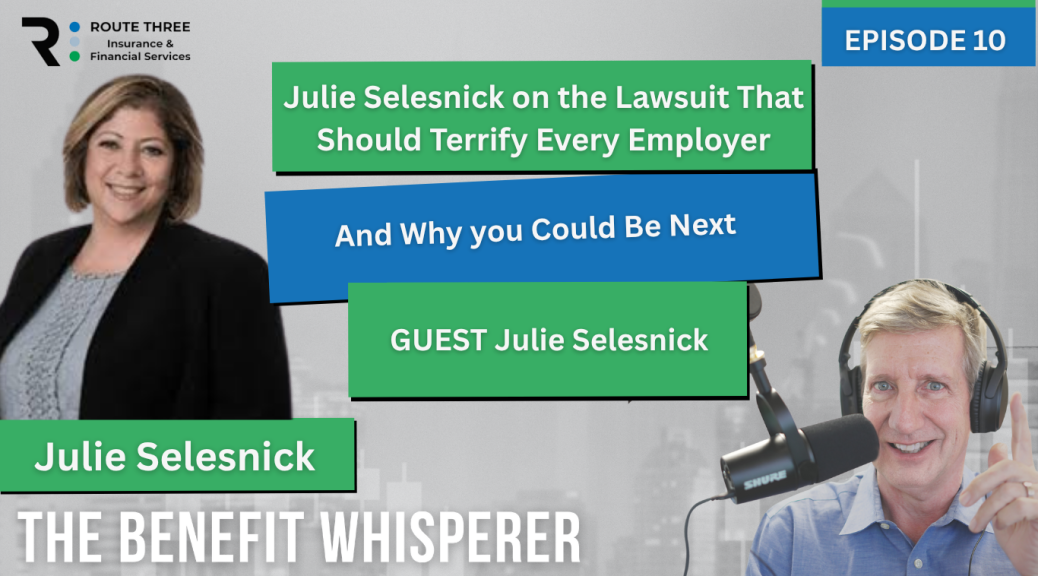
Julie Selesnick on the Lawsuit that Should Terrify Every Employer and Why You Could Be Next (Ep. 10)

In this must-watch episode of The Benefit Whisperer, Ralph Weber sits down with ERISA attorney Julie Selesnick to unpack one of the biggest legal stories in employee benefits: the JP Morgan healthcare lawsuit—and why it should matter to every employer and plan sponsor.

Julie brings 25+ years of legal experience and explains:
✅ What the JP Morgan case is really about
✅ Why PBMs (Pharmacy Benefit Managers) are under bipartisan fire
✅ How employers unknowingly violate fiduciary duties
✅ Why your broker might be working against your best interests
✅ What you must do now to protect your business and employees

This episode is essential for:

  • CFOs, HR Leaders, and Benefit Managers

  • Business owners with self-funded health plans

  • Anyone responsible for healthcare plan compliance

🎯 Learn how to safeguard your company from costly lawsuits and build a benefits plan that actually works.

🔔 Subscribe now for insider insights, unfiltered truths, and actionable strategies to reduce healthcare costs and improve employee benefits.

👉 Contact Ralph Weber:
📧 Ralph@TheBenefitWhisperer.com
📞 832-924-3330
🌐 www.thebenefitwhisperer.com

00:00 Introduction to Healthcare Law and ERISA

03:01 The Impact of the CAA on Healthcare Plans

05:58 Legal Trends in Pharmacy Benefit Managers (PBMs)

08:53 Understanding the JP Morgan Lawsuit

12:04 Fiduciary Duties in ERISA and Non-ERISA Plans

14:56 Potential Ripple Effects of the JP Morgan Case

17:59 Lessons for Employers from Recent Lawsuits

23:55 Understanding Controlled Groups and ERISA

26:28 Best Practices for Health Plans

31:15 The Future of Healthcare Litigation

37:48 Advice for HR Leaders and CFOs

39:54 The Importance of Benchmarking in Healthcare

#JPmorgan #HealthcareLawsuit #ERISA #PBMs #HealthPlanCompliance #EmployeeBenefits #JulieSelesnick #TheBenefitWhisperer #RalphWeber #TransparencyInHealthcare