Tag: healthcare waste

The Dallas Health Plan, Part 2: What’s Hiding in the Contract? | Mark Cuban, Chris Deacon, Marilyn Bartlett (Ep. 57 – Part 2 of 3)

The Dallas Health Plan, Part 2: What’s Hiding in the Contract? | Mark Cuban, Chris Deacon, Marilyn Bartlett (Ep. 57 – Part 2 of 3)

Subscribe to my YouTube Channel for a lot more:  http://www.youtube.com/@BenefitWhisperer

The headline fee is not always the whole deal. The contract determines what the employer actually agreed to.

In Part 2 of our three-part series on the City of Dallas health plan, Ralph Weber is joined by Mark Cuban, Chris Deacon, and Marilyn Bartlett to examine the contract structures, payment arrangements, fees, and incentives that employers and public plans need to understand before signing an agreement.

The discussion begins with Chris Deacon explaining why the most important provisions may not be found where an employer expects them – and why reading the fine print matters. From there, the conversation moves into large-claim management, hospital payment arrangements, PBM and ASO compensation, procurement practices, and the importance of understanding who is being paid, how they are being paid, and what authority the plan sponsor has retained.

In this episode:

  • Why contract exhibits and negotiated provisions matter
  • Why large claims should be reviewed in real time
  • The difference between an aggregate discount guarantee and what may happen on an individual high-cost claim
  • Why employers should focus on the actual price paid – not simply the percentage discount
  • How PBM and ASO compensation can affect incentives
  • What Chris Deacon learned from New Jersey’s procurement approach
  • Why Mark Cuban believes vendors should be paid for the services they actually provide
  • How RFP design can shape the outcome before negotiations even begin
  • Why employers should understand prior authorization, denials, related entities, and potential conflicts
  • Why Marilyn Bartlett says plan sponsors cannot simply sign the contract and walk away

The episode closes with a basic but powerful reminder:

It’s your money.

If an employer or public entity is funding the health plan, it should understand the contract, the incentives, the payment flows, and the rights it has retained.

This is Part 2 of 3:

Part 1 – Visibility: What can Dallas actually see?
Part 2 – Contracts & Incentives: What does the fine print actually permit?
Part 3 – Control: What should Dallas and other employers do about it?

Guests:
Mark Cuban – Entrepreneur and Co-Founder of Mark Cuban Cost Plus Drug Company
Chris Deacon – Healthcare attorney and former Director of the New Jersey Division of Pensions & Benefits
Marilyn Bartlett, CPA – Nationally recognized healthcare cost-containment leader and former administrator of the Montana Employee Health Plan

Host: Ralph Weber | The Benefit Whisperer | Route Three

Subscribe for Part 3, where the conversation turns from identifying the problems to what Dallas – and other employers – can actually do differently.
Subscribe to my YouTube Channel:  http://www.youtube.com/@BenefitWhisperer

Music licensed through Soundstripe.
Code: YTA6TLJZGWC58KTH
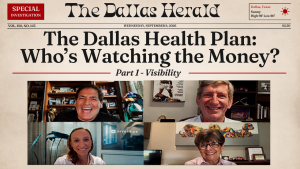
The Dallas Health Plan, Part 1: 99% Accurate – – But 99% of What? | Mark Cuban, Chris Deacon, Marilyn Bartlett (Ep. 57 – Part 1 of 3)

The Dallas Health Plan, Part 1: 99% Accurate – – But 99% of What? | Mark Cuban, Chris Deacon, Marilyn Bartlett (Ep. 57 – Part 1 of 3)


Subscribe to my YouTube Channel for a lot more: http://www.youtube.com/@BenefitWhisperer

The City of Dallas is facing rising healthcare costs and the possibility of higher costs or reduced benefits for employees. 
But before making those decisions, there’s a more fundamental question: 

Can the people paying the bills actually see and verify what they’re paying for? 

In Part 1 of this special three-part series of The Benefit Whisperer, Ralph Weber is joined by Mark Cuban, Chris Deacon, and Marilyn Bartlett 
to examine the City of Dallas health plan through the lens of claims visibility, audit rights, contract accountability, and active health-plan management. 

The conversation explores: 

• What does a “99% claims accuracy rate” actually measure? 
• Why claim-count accuracy and claim-dollar accuracy are very different 
• What Mark Cuban found after obtaining and reviewing the Dallas health-plan contract 
• Whether limiting an audit to a small number of claims gives a plan meaningful oversight 
• Why employers need access to their underlying claims data 
• How Marilyn Bartlett approached claims, banking, and large-case management in Montana 
• Why Chris Deacon believes employers must look beyond headline administrative fees and examine the actual contract terms 
• Why Mark argues healthcare needs to be managed like any other major business expense 

One of the central questions in this episode is simple: 

Before asking employees to pay more, shouldn’t the organization funding the health plan know exactly where the money is going? 

This is Part 1 of 3. 
Part 1: What Dallas Can’t See - and Why That Matters 
Part 2: What’s Buried in the Contract and Incentives 
Part 3: How Dallas - and Other Employers - Take Back Control 

Subscribe for Parts 2 and 3: Subscribe to my YouTube Channel and watch the video podcast!

Guests: 
Mark Cuban - Entrepreneur and Co-Founder of Mark Cuban Cost Plus Drug Company 
Chris Deacon - Healthcare attorney and former Director of the New Jersey Division of Pensions & Benefits 
Marilyn Bartlett, CPA - Nationally recognized healthcare cost-containment leader and former administrator of the Montana Employee Health Plan 

Host: 
Ralph Weber | The Benefit Whisperer | Route Three
The Business Model Behind America’s Healthcare Crisis | Elisabeth Rosenthal (Ep. 56)

The Business Model Behind America’s Healthcare Crisis | Elisabeth Rosenthal (Ep. 56)

What happens when healthcare stops behaving like a public good and starts behaving like a financial business?

In this episode of The Benefit Whisperer, Ralph Weber sits down with Elisabeth Rosenthal to examine the business model behind America’s healthcare crisis – and why employers, patients, and families continue to absorb the consequences.

Elisabeth argues that healthcare has increasingly become a financial instrument, shaped by opacity, administrative friction, consolidation, and incentives that often have little to do with delivering better care. The result is a system where patients can become secondary to the transaction, while employers continue funding rising costs without fully exercising their power as purchasers.

Ralph and Elisabeth discuss:

- Why so much money is made from complexity and friction
- How insurers, hospitals, and intermediaries benefit from the current structure
- Why high deductibles and coinsurance can create devastating medical debt
- The growing impact of consolidation and vertical integration
- Whether direct contracting can actually reduce cost and complexity
- Why employers have historically been “asleep at the wheel”
- What self-funded employers should understand about their leverage
- Why transparency matters, but is not enough by itself
- What it will take to create a healthcare market that works better for patients and purchasers
- AND MUCH MORE!

About Elisabeth Rosenthal

Elisabeth Rosenthal is a senior contributing editor for health news analysis at KFF Health News. She joined the organization in 2016 as editor-in-chief after spending 22 years as a correspondent with The New York Times, where she covered healthcare, the environment, and international issues from Beijing.

A graduate of Stanford University and Harvard Medical School, Rosenthal briefly practiced emergency medicine before moving into journalism. Her acclaimed reporting series, Paying Till It Hurts, explored the rising cost of American healthcare, and her book, An American Sickness: How Healthcare Became Big Business and How You Can Take It Back, became a New York Times bestseller.

For CEOs, CFOs, HR leaders, benefits professionals, brokers, TPAs, and anyone responsible for employer-sponsored healthcare, this episode raises a fundamental question: If employers are paying the bill, why aren’t they exerting more control over how healthcare is purchased?

Subscribe and follow for practical conversations about healthcare economics, employer-sponsored benefits, transparency, direct contracting, and strategies for taking greater control of healthcare spending.

Subscribe to my YouTube Channel

Subscribe to my Substack Page

Follow my LinkedIn

$1 Trillion in WasteHealthcare Contracts and Digital Legos (Ep. 33)

$1 Trillion in WasteHealthcare Contracts and Digital Legos (Ep. 33)

Ralph Weber welcomes back Dr. David Scheinker, Executive Director at Stanford Children’s Health and founder of SURF Stanford Medicine. Together, they tackle the inefficiencies buried in hospital-payer contracts and how lack of standardization drives up costs. Dr. Scheinker shares how his team uses operations research and optimization modeling to streamline care, reduce waste, and protect patients financially. Topics range from pediatric ICU efficiency to lessons from aviation and finance. Plus, why AI and LLMs could revolutionize hospital systems—if used wisely.

Schedule a FREE consultation with Ralph: bit.ly/47JjX6b

Guest: Dr. David Scheinker | LinkedIn: https://www.linkedin.com/in/david-scheinker/

Host: Ralph Weber CEO of Route Three and host of The Benefit Whisperer podcast | Website: FixMyBenefitsNow.com | Email: Ralph@TheBenefitWhisperer.com LinkedIn: https://www.linkedin.com/in/ralphweber


Chris Deacon: $2B Scam Broker Kickbacks & PBM Profits Fiduciary Duties Exposed (Ep. 27)

Chris Deacon: $2B Scam Broker Kickbacks & PBM Profits Fiduciary Duties Exposed (Ep. 27)

Guest: Chris Deacon, author of The Great American Healthcare Heist and former Director of Health Benefits, State of New Jersey.

Chris joins Ralph Weber to reveal how her team saved $2 billion, including $400M annually on pharmacy spend, by exposing PBM shell games, fixing contracts, and enforcing fiduciary duty.

📌 Topics:

  • How much waste is really in your health plan (30–40%)
  • Reverse auctions and pass-through PBMs explained
  • Why discount guarantees are often a scam
  • Contract terms every plan sponsor should demand

🎧 Listen now to understand how to stop paying for other people’s profits.

📘 Buy the book: The Great American Healthcare Heist

 🔗 Connect with Chris:https://www.linkedin.com/in/cdeaconc/

📬 Questions? ralph@thebenefitwhisperer.com · fixmybenefitsnow.com

America’s $1 Trillion Healthcare Problem: David Sheinker on How to fix it (Ep. 15)

America’s $1 Trillion Healthcare Problem: David Sheinker on How to fix it (Ep. 15)

What if the real problem with American healthcare isn’t medical but the familiar broken system that keeps your costs rising year after year? In this episode of The Benefit Whisperer, Ralph Weber sits down with Dr. David Scheinker, Founder and Director of SURF Stanford Medicine, to unpack:

Why rising costs are baked into the insurance model

How digitization, wearables, and standard contracts could finally cut the waste

What smart employers are doing now to fight back without waiting on Washington

If you’re an employer tired of paying for inefficiency and administrative games this conversation is your roadmap to do better.

👉 Watch the full episode and share it with your team.

👉 Subscribe to The Benefit Whisperer for real solutions.

👉 Book a free consultation with Ralph: https://bit.ly/3T6TUz0

👉 Follow David Sheinker’s work or get in touch: https://surf.stanford.edu/

Learn more: https://www.thebenefitwhisperer.com


00:00 Introduction to Healthcare Reform

01:23 The Vision for a Smarter Healthcare System

04:04 The Ma Bell Problem in Insurance

05:22 Insurance Profits and Healthcare Spending

06:26 The Medical Loss Ratio and Its Consequences

09:24 The Role of Competition in Healthcare

11:00 Direct Contracts and Innovative Health Plans

11:59 The Impact of TPAs and PBMs

13:02 Complexity and Transparency in Healthcare

15:33 Empowering Employers in Healthcare Decisions

17:43 Digital Medicine and Remote Patient Monitoring

19:12 Standardization in Healthcare Contracts

22:51 Medicare Advantage: Reform or Privatization?

24:18 Healthcare as a Human Right

25:37 Policy Tools for Healthcare Reform

27:31 Myths About Healthcare Reform

28:44 Final Thoughts on Healthcare Efficiency

Why Insurers Profit from Complexity and you Pay the Price with Guest David Scheinker (Ep. 14)

Why Insurers Profit from Complexity and you Pay the Price with Guest David Scheinker (Ep. 14)

🎧 Episode 14: Dr. David Scheinker on Why Healthcare’s Complexity Isn’t an Accident

This week on The Benefit Whisperer, Ralph Weber is joined by Stanford’s Dr. David Scheinker, a leading voice in healthcare engineering and reform, to break down the $1 trillion in administrative waste baked into the U.S. healthcare system.

From vague insurance denials to year-long billing delays, Dr. Scheinker explains why these inefficiencies aren’t glitches, they’re features of a system designed to protect profits, not patients.

🔍 In this episode:

  • Why it took a year to bill for a pre-approved procedure

  • How AI is being used to fight appeals and deny claims

  • What the mortgage industry can teach healthcare

  • The root cause of system-wide complexity—and who benefits from it

If you’ve ever wondered why fixing healthcare feels impossible, this conversation offers rare clarity—and hope.

For benefits plans that eliminate waste and put employers back in control, visit routethree.com